


Data Science Hangout (Rachael Dempsey, Posit & Matthew Montero, GenRe) | posit::conf(2025)
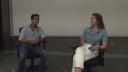
That's right, a LIVE IN PERSON Data Science Hangout! Rachel Dempsey introduces Matthew Montero, Chief Data Officer at GenRe, who shared his journey from actuary to technology leader. He emphasized the importance of effective communication between IT and business, as well as the need for a strong enterprise data architecture. Matthew discussed the challenges of productionalizing data models and the significance of community support in adopting new tools like R. If you'd like to attend a Data Science Hangout, we'd love you to join us. We meet (almost) every Thursday at 12PM ET, and you can register at pos.it/dsh. Everyone is welcome! It doesn't matter what your background, years of experience, or preferred tools are
image: thumbnail.jpg
Transcript#
This transcript was generated automatically and may contain errors.
I'm Rachael Dempsey. I lead Customer Marketing at Posit. I guess about four and a half years ago, we started something called a Data Science Hangout, where every single Thursday we get together online as a community, and we have a different featured leader join us as our guest. Matthew Montero, Chief Data Officer at GenRe, has been one of those featured leaders before, so I'm excited to have him here in person too.
But if you haven't had a chance to join the Hangout before, if you're listening virtually and want to get back together with this amazing group of people, every single Thursday, Libby Heron now hosts the Data Science Hangout. She's the real host now. I'm sure she's sharing the link right now in Discord, but you can also just Google Posit Data Science Hangout, and you can join us from 12 to 1 Eastern Time every single Thursday, unless it's a holiday.
But for today, because we are in person too, if you want to ask questions, just raise your hand, because the thing about the Hangout is it's all powered by you, so all the questions are audience-based. But you can also ask things anonymously too, so in the Positron Lounge channel in Discord, put questions in there. I have my phone, I just remembered, and I will look at Slido to ask it. But to get us started, Matthew, would you be able to introduce yourself, share a little bit about your role, and something you like to do for fun too?
Matthew's background and role
Yes, so I'm Matthew Montero, Chief Data Officer of GenRe. First of all, what is GenRe? GenRe is a global re-insurance organization. We write about $14 billion of business. Again, we're globally, so we have to think about everything we do both in North America and throughout Europe, Asia, and other countries.
And so we sit within global IT, so we focus on how we enable technology throughout. So this might be all the way from data science components, but also data reporting, data engineering, and data governance, of course. My background actually started off as an actuary on the NCCI, which is a workers' counter rating bureau. And I started there just as an actuary trying to learn about utilizing R at that time, and then that's when I got introduced with RStudio at that time. And it just grew out to something bigger than that.
I eventually created an analytics group within that organization, and then brought that on to Sanofi, which is a pharmaceutical company, a global one, where I got my first taste of what it means to be a global company. And eventually moved on to GenRe.
So I do have four kids, so four, six, eight, and ten years old. And that takes up all the rest of my time of my daily life. But they are very active, so we do soccer as well as running. So every single week I basically run six miles to keep my daughter up to speed with her endurance.
What it means to be a chief data officer
So one of the key aspects is being able to take IT jargon and be able to communicate that to the business, but mostly related to data and technology. So one of the key things was bringing in what we call enterprise data architecture. So having a way to be able to get data out of these applications, anything you write in Tree, type into applications, and try to get data out of there, and do something with it. And it's not as simple as just pulling something, manipulate it, and spread it out somewhere else. You've got to have an actual, defined process around that.
So that's one of the things that I do. Well, how do you define that? How do you support it? Keep it up and running. After you put something into production, midday or midnight, something might go wrong because Australia is using it in their day-to-day life, and who's going to be up there waking up to be able to support that? So we had to create that production support model.
One wing within this area, again, is data science. So we do want to look at how do we do new tooling, how do we do new products, how do we build capabilities to allow actuaries, underwriters, or anyone to be able to create applications, demonstrate, do POCs. But building out where we can have a guardrail around that, meaning that we want them to be safe with whatever they're trying to do. So meaning not accidentally sharing data outside of our network, making sure we have enough guardrails to make sure that doesn't happen.
Productionalizing models and change management
As a data scientist, the most challenging part I had in my career was putting something into production, something that was... Okay, so let me give you a little back story. The part I was in at NCCI was part of an economics group, and they basically generated models. And my job was to take those models, productionalize it, create an application or create a report around it, and be able to work with the actuaries to actually use that in their day-to-day work.
But a challenging part was going from something that is model-based, it was based on Bayesian modeling, to something that you're looking at averages, and three- or four-year rolling averages, and they're used to that. And how do you incorporate those two? How do you explain how that works? And what I found, a lot of it is, one, education, and getting more used to your regular work, but then, two, it's change management. We all are going through this now with AI, or earlier on with analytics, is that it's going to happen, it's just how do you explain from a leadership, so top-down perspective, and also from a bottom-up perspective, how do you get people used to it and get on board with it? And then once they start using themselves and see that it actually is beneficial, then that's when you start the snowball effect.
Career trajectory to CDO
Actually, right when I was leaving college, I was up to college, I was wanting to be an actuary. I was always about math, statistics, and then when I started my career, during my schooling, I also did mechanical engineering, so I had a programming background. We were required to understand Java, C+, and then with statistics, we learned R. So I came in with three different languages.
And because of that, they got me into this economics track as well to work with code to build things. And that's what I got for my first taste of technology. I was like, this is actually pretty interesting. It got more and more interesting. And then I started thinking, oh, these actuarial processes we have, we use Excel, we use all this stuff, and we can simplify this or we can automate pieces of this. And I built it using R. And so that got me more and more interested.
So at that point, I knew that I didn't want to be an actuary much anymore. Because one, exams were tough. I did get through exam five. To get to exam six, you get your first credential. I think the percentage of passing is 50% every single time you get to your next exam. So if you can do the math, it gets pretty difficult on how many people actually get through all of them. And so then I got really into, well, then I got into technology. I went back to get my master's degree in computer science. And then I learned more and more about why technology is the way it is. And then that's when I shifted away from actuarial type of position to more of an analytics position.
So when I moved to Sanofi, I was the global analytics lead. And so building an analytics team, and all focused on how to work with the business to create products. And then at that point, and I learned more about leadership at that point, because I had to push against or push to leadership. We need to expand, we need to do more, because, well, I get all these requests in business, but we're only so big. And then that's when I learned that, well, there's different flavors of leadership, and I needed something different on my trajectory.
So then when I moved over to GenRe, I was given that opportunity where we're a very lean organization. We only have 100 IT staff, and essentially you're a fish in a very small pond. So it's very easy, as long as you do very well, and have a goal, and have strategic vision, it's a very good, easy way to move up.
Leadership advice and book recommendations
There's one, Seven Habits of Effective Leadership. Yes, highly effective leadership. So that book actually was a very big game changer for me. And it was more, not really about the actual seven itself, but it was one of them that focused on that the only thing that someone, when someone impacts you, so say someone makes you sad, or makes you happy, or whatever, it's you yourself who actually allows that impact to happen. So meaning, they're not forcing you to be sad, they're not forcing you to be upset, you're allowing that to happen. And the moment I really realized that, everything changed in my perspective of how to lead, how to live day-to-day life, and I incorporate that everywhere I do now.
And the moment I really realized that, everything changed in my perspective of how to lead, how to live day-to-day life, and I incorporate that everywhere I do now.
Getting actuaries to adopt R
So the way we did it, pre-the company, was that we actually got a lot of actuaries to start learning R. And we got to a point, I think it was around 2022, people who were part of this what we call actuarial programming team, that were building with R code. And so that I think was starting a, I don't know what ended up happening, I was there for 10 years, I think it was like year 8 that we started this group, but I don't know what ever happened to the end of that. But at that point it was growing, and a lot more people were using it, seeing the benefits of it.
Yeah, we built a community group within the organization. And so they started using it more. And so I think that's one piece of it, is just building community, getting that to work. And we did the same thing in January, we built, we have an internal R group as well, where we share what we build, how we build it, and any challenges people have around. So they do have a community there too.
Yes, so I was at the time, one or one of two R programmers there, that have actuarial background. So in the beginning, so it was just me building these applications, and showing how we can automate certain things. And people got interested in it, and they're like, oh this is neat, this is cool, I want to do this too. Because they did get interest, all the way up to the chief actuary at the time. So that's, you do want to get that person's interest. And so I think it kind of snowballed at that point. So from showing and telling.
Building and maintaining an internal community
Right, so we had a dedicated individual, who was in charge of overseeing the community. So that was one big thing, it's a community of dedication. You also need the support of both the business side, and also the IT side. So IT is going to be there to keep it up and running, making sure the features are available, to make sure that if you have challenges, is it a just you challenge, or is it a challenge that you have across everyone else, to be able to get it connected to different systems, to make it just work very well for everyone.
But then from, so you need that hook into the community, but then also on the business side, you need to make sure you get the people who are the champions of the tooling. So we're a global company, so we want to look for people who are in Germany, we want to look for people who are in the US, we want to look at people that are in Singapore. And that way, because then they will keep on promoting the product. They're already champions, that means that they're already interested in telling people about it, but if you get them empowered within the community to have a better voice, to have a better channel to be able to communicate that, then it helps a lot.
So for us, RStudio Posit came in on the IT side. That was one of my first things when I came into GenRe was bring in Posit and support it and build it. So it was bringing in someone who actually has a background in that platform and in the language. And then from there, I brought in some people who can help build a community. And then eventually brought in Chris Engelhardt also to oversee after I was done overseeing the area, Chris overtaking that. And the idea is that you need someone who has a pull to be able to fix things that the community might bring up because if community brings up challenges and no one actually does a fix it, it kind of dissolves the community.
But also is if people want more, a way to present or be appreciative of what they've built and other people see what they've built, this is another venue to do that. It is a lot of effort to curate an agenda all the time, to be able to send out the notices, how the cadence is, making sure that the community runs effectively. But we took a lot of what you were doing, the format and whatnot, we tried to do something very similar to that because it works and it works on a much bigger scale. And so we just look at where do we see examples elsewhere. We do tend to see a lot of the same people presenting, but that's okay because other people are listening. But we do try as much as we can to get other people to present as much, especially when we hear on the side, oh, this person's working on this, oh, great, let's present this.
Missing coding and the engineering mindset
Yes, that's funny because it was yesterday that I got my first notice that I have not touched Posit for 30 days. And in our company, if you do that, you actually lose your license within the next 30 days, which is a sad moment. That's the first time ever I've gotten that. But no, I do miss coding. I haven't encoded as much as I used to. Even when I started at GenRe, I did code a lot for the first few years. I actually built presentations, did my R markdowns at the time, came up with how to create websites and all that.
But lately, I have a bigger team that can support that and build that. I can roughly draft things out, and I can send it over to them and say, can we build this? I try to, at least in my mind, how I work constructively with code, because to me it's very important to have an engineering mindset. So in an organization that I oversee, every single person who directly reports to me has an engineering background. This is a requirement. And it's because of that that we are much more of a structured way in terms of how we communicate, how we come up with thoughts, how we come up with solutions.
So going back to yes, I do miss coding a lot, because I did like creating new things. I'd be the first one to test out these different packages and build something with it and be able to demonstrate that to people. But now I get to enjoy watching other people do it.
Bridging IT and business
The question I had for you is, I've talked to so many people from the community who have this challenge of communicating with IT sometimes, and the disconnect between IT and business data science users, and it feels like that's something that isn't a problem at GenRe, and I'd just love to hear a little bit about that or what advice you have for us.
I would say, I think it's just a general problem or challenge that you're going to have, regardless of the company, regardless of the organization set up. And it's just because it's a telephone thing that happens, right? So you're going to have one group of individuals who know what they want or think what they know what they want, and they're going to use some plain language, business-oriented language, and then they hand it off to someone else. But then that someone else is not in their mindset, doesn't have the same background, doesn't have the same knowledge in terms of their business processes, so there's going to be loss in language.
And the same happens all the way around when the IT folks want to speak to the business side. And that's why I think when you have someone who came from the business, became IT, or someone in IT came to the business and learned the business side, that's when you're going to get that interpreter. And that's going to be key for any type of change management, any type of project where you're trying to work very closely together because you want to build something new.
It is a very, I think it's a difficult task. It's something I still work on because I'm, all these new concepts, like with the whole AI stuff, like this is a very complex type of thing to describe and all the different levels of generative AI. It went from generative AI to agentic AI. And trying to explain that to a non-technical people to understand that and then understand it from all the media we hear and try to mix it all together, it's a lot of work.
Infrastructure for deploying models
So the first question would be, are you ready to support it whenever it crashes? So sometimes there are models in which it's okay. During business hours, it's only ran a couple times a year or a couple times a month. And then no one needs to worry about support. That's perfectly fine. It's only when you think about moving into something that needs full support. It's something you're going to have up and running 24-7. Somebody might ping in. Someone might need to use it. And if it fails, who's going to support it? That's only when you really have to think about that.
There's a lot of packages out there that at least build you a CICD pipeline or help you build a CID pipeline. And ensure that you at least have some type of rigid process in there to elevate things from your dev tests and QA into prod. And at least you can have some structure around there. So at least you have version control and all that. So I would suggest go that route to at least have that in the minimum. And then only when you need to consider about supporting it more than your business hours, then you need to think about the infrastructure. The infrastructure does take time.
Building an analytics team from scratch
So there's two routes that happened through my career. One was I was essentially the sole person, and then I just built examples of solutions and then started a snowball effect that people started learning and started building their products. So that was one way. Because then you start getting people's buy-in, and then people are going to start building a team, and then you start getting bigger. So that's one way of building.
The other way is finding the champions. So if your company is big enough, you can be like, oh, anyone else is interested in R, who are the R programmers here, who are people who have been doing this for a while. And then you can easily find out who are the champions, who are the ones who are wanting to learn or interested in learning. And then you start bringing them together. So it would be very much of that informal, ground-roots way of doing it. But it works.
We actually built an AI team as well, as a community now, for that. And it's the same idea, is we just find those champions, bring them together, start having some informal meet-ups, and then it comes from there. And eventually, the executive or the leadership level will say, oh, there is a need for this. And then, hopefully, there will be some support from actual roles in that position.
Technical responsibilities of the CDO role
So as a chief data officer, I am responsible for the complete enterprise data architecture, so the high-level data flow mapping. So how does, from an application or from sources, how is that going to flow all the way down through all the different systems, all the different setups we have, all the different environments, all the way to creating those reports that we need to submit for regulatory purposes? How do we have a whole support team around all that? How do we cut things up depending on different development teams? That is my responsibility on determining what that's going to look like.
Then I hand that over to my direct reports who then need to operationalize that, meaning that they need to take that design and say, okay, I am responsible for data engineering. From our strategy, we are all Azure shops, so whatever my tooling is, I'm allowed to do that. Well, it's going to be Databricks. Or from a data science perspective, it's going to be Posit. And then, again, operationalize that, then going a little further, and how are we setting it up? What's the infrastructure going to look like? It's very much at me setting up that overall vision, some of the different strategy points in there, the principles we need to make decisions on, and then my direct reports will come up with the solutions around that.
Closing advice
Yes, now I'm just trying to think. There's many different things I've been told over time. It's the positive thinking. So whenever I write, do writings, or whenever I try to communicate, I always try to do more of the positive spin of it. So if there is a challenge, like, well, you're learning from your challenges. So every single challenge that happens, and that's why we use the word challenge too, instead of saying problem, because the challenge means that you have is an active piece where you can help us come up with a solution. But you always want to come with a positive spin with it because what is today is going to change tomorrow, right? So you always want to be able to find ways to improve yourself. And so the positive part of that is always that there is always a tomorrow to be able to fix it.
But you always want to come with a positive spin with it because what is today is going to change tomorrow, right? So you always want to be able to find ways to improve yourself. And so the positive part of that is always that there is always a tomorrow to be able to fix it.
Well, thank you all so much for taking the time to join us today, both if you are joining virtually or if you're here in the room. I just wanted to remind everybody, if you have never been to a data science Hangout before, I'd love to have you join us virtually. So every single Thursday from 12 to 1 Eastern Time, we get together. You can look on the Posit website, Google it. I'm sure Libby's sharing it in the Discord again here too. But thank you so much, Matthew, for joining us too.