


What I Wish I Knew Before Becoming a Data Scientist - posit::conf(2023)
Presented by Kaitlin Bustos In this talk, I'm sharing my personal journey as a data scientist and the key lessons learned along the way. I'll emphasize the importance of finding a positive community of like minded-allies, persevering through setbacks as success is not linear, and exploring by embracing the broad nature of the data science field. By sharing my experiences and acknowledging the challenges I've faced attendees will gain a fresh perspective on what it takes to succeed in a data science career and inspire them to pursue their passions in the field. Overall, this talk aims to provide a glimpse into the reality of a data science career. Attendees will take away a sense of motivation and empowerment to find their own unique path to success. Presented at Posit Conference, between Sept 19-20 2023, Learn more at posit.co/conference. -------------------------- Talk Track: Lightning talks. Session Code: TALK-1169
image: thumbnail.jpg
Transcript#
This transcript was generated automatically and may contain errors.
Hi, my name is Caitlin Bustos. I am a data scientist and I'm so excited to be here today to speak to you all about what I wish I knew before becoming a data scientist. So as a scientist, I tend to hypothesize on many aspects of my life, including what my career might look like. So I'm about three years into my career now and my expected trajectory looks vastly different from the reality of my career. So here was my misconception about what my career might look like and opposed to the reality.
So within my experiences of being a tutor, intern, subject matter expert, consultant, mentor, and scientist, I've definitely learned a lot of lessons along the way, of course, some of which are technical lessons like what would have saved me hours of debugging or what packages I should have loaded in sooner. That's not what this talk is about today, though I'll give an honorable mention to Dockerfiler because imagine me trying to create a Dockerfile from scratch for 12 hours on a Sunday. This talk is really about the human lessons that I've learned navigating my career for the first time. And in sharing these lessons with you, I hope that no matter what role you may hold now or what stage of career that you're in, you can resonate with some of these lessons or if you're an aspiring tech professional, you can take these lessons as a heads up.
So the first thing I learned is that success is not linear. Second, I learned the importance of exploring but also finding your focus. And thirdly, I learned to count on community.
Success is not linear
So diving into the first one, success is not linear. So here's a plot of my perceived successes and failures three years into my career. And if we look at this line of best fit, we can see that it was not an upward trajectory and that there were several peaks and valleys that I experienced. So why shouldn't we always expect an upward trajectory? Well, there are several different factors that change over time, such as external factors, such as shifting role responsibilities, emerging industry trends or changing economic conditions. And there's also changing internal factors, like maybe you create new goals for yourself, your interests change or develop, maybe your priorities shift.
So given these changes, it's inevitable that they can also bring about challenges and some of which challenges won't always catapult you upward. So I just recommend embracing your perceived failures, knowing that there's going to be a success around the corner.
So I just recommend embracing your perceived failures, knowing that there's going to be a success around the corner.
Explore and find your focus
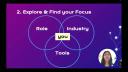
Next, explore and find your focus. As a professional, you need to choose a role, industry, and then the different tools and technologies you're going to use to be successful in that role. So this is an overview of what just the data science landscape may look like. There's so many different roles associated to being a data science professional, several different industries you can work in, and so many tools and technologies that you're likely to encounter throughout some points of your career.
So given the vast number of roles, industries, and tools and technologies, there's approximately 32 million combinations of choices that you're faced with considering one role, one industry and about three tools and technologies. So to deal with all of these choices, I highly recommend finding your focus. So start on something, but don't forget to explore since there are so many different directions you can go. And many skills, which are also transferable that can help you go from one role to another or one industry to another.
Count on community
Thirdly, count on community. I'm personally a part of different women in tech communities and different data science communities. And throughout my engagements with these communities, I've developed a great sense of purpose solely by just showing up. Next, I've gained a great sense of connectedness by being able to relate to the individuals, a part of these communities. I think you'd be surprised how many people share similar stories and experiences to yourself.
Next, I've gained a great sense of inspiration, just being surrounded by like-minded, humble, and incredibly talented individuals in the tech industry doing some really cool things. I want to give an honorable mention again to the data science hangout. This is where I've developed my core community. And I think we've been very helpful to each other throughout all of our careers.
So in summary, by embracing a nonlinear career path, finding your focus through exploration and leveraging the community, I hope that these lessons help you thrive in your tech career. So thank you so much. Feel free to check out my website, connect with me on LinkedIn. And if you want to create your own career reflection plot, the code is on GitHub for that. So thank you so much, and I hope you enjoy.