


Black Hair and Data Science Have More in Common Than You Think - posit::conf(2023)
Presented by Kari Jordan Data science is often difficult to define because of its many intersections, including statistics, programming, analytics, and other domain knowledge. Would you believe it if I told you Black hair and data science have much in common? This talk is for those considering learning about, studying, or pursuing data science. In it, Dr. Kari L. Jordan draws parallels between approaches to caring for Black hair and approaches to learning data science. We start with the roots and end by picking the right tools and products to maintain our coiffure. Presented at Posit Conference, between Sept 19-20 2023, Learn more at posit.co/conference. -------------------------- Talk Track: It takes a village: building and sustaining communities. Session Code: TALK-1131
image: thumbnail.jpg
Transcript#
This transcript was generated automatically and may contain errors.
Good afternoon, good afternoon, that was lit, okay, so good afternoon everyone, yes, I'm Keri Jordan, Executive Director for The Carpentries and this is my beautiful Afro-textured hair.
So while Afro-textured hair and data science may seem like two unrelated topics, some intriguing similarities are worth exploring. So in my short talk, I'm going to share a few interesting similarities in hopes that by exploring them, you'll be inspired to embrace diversity, creativity, and collaboration in your R projects.
So here's a quick overview of how we'll spend our time together. I'm going to give you a little bit of background about myself and my journey to data science. From there, we'll get into the bulk of my talk and I'll tell you about some organizations that I love that are doing the work to advance equity in data science.
Now, it can be very difficult to step away from life, I have a three year old, I'm sure you've seen her roaming around the conference. It can be difficult to step away and be present in the moment, but I want us all to take advantage of this opportunity, I want to set some agreements, I want us to agree to give each other our undivided attention and to also agree that this is a welcoming and inclusive environment and though I'm the person that's in front of the room, we're all going to learn a little something from each other. And let's agree that we're going to share at least one thing that we learned today with someone else.
Background and journey to data science
Can we agree? Perfect. So after earning bachelor's and master's degrees in mechanical engineering, I decided to pursue a PhD to address the fact that there weren't enough people who look like me in STEM. I read an article in the Harvard Business Review and the name of the article was called Stop Telling Women They Have Imposter Syndrome.
And so in this article, they explained that my illusion or my feeling like an outsider, it actually was not an illusion, it was the result of systemic bias and exclusion. So rather than complain about bias, exclusion, all the things that I've been through growing up in Detroit, I chose to be part of the solution and so I joined the Carpentries team in 2016 and I've been advocating for equity in open science ever since.
One night I was decompressing as I do and I came across this documentary on Hulu called The Hair Tales. So in this documentary, it was a group of women who were sharing stories celebrating black women's identity, beauty, culture, and humanity through the lens of their hair. Now Afro-textured hair or black hair is common among those with bloodlines leading back to the tropics and sub-Saharan Africa. Each strand grows in sort of a helix shape and it appears denser than straight hair and for that reason, it can be styled in unlimited ways.
I got through about half of the first episode of the documentary and I thought to myself, black hair and data science have a lot in common. I wonder if people know that. And that is the reason I'm here today, to tell you about those things.
My data science journey has been as wild as my hair journey, okay? Super complex. Lots of twists and turns, trial and error, consultations with friends and colleagues and trusted advisors. I started using spreadsheets. I learned SPSS or did I learn it, actually? I don't think I learned it. I used it. I used SPSS. And now I'm dabbling in R.
Parallels between Afro-textured hair and data science
By appreciating the parallels between Afro-textured hair and data science and identifying the tools that you can use for both, you can get involved with data science to solve problems for your community and any problems that are important to you.
Both Afro-textured hair and data science are complex. Afro-textured hair is known for its diverse textures, curl patterns, and unique styling needs requiring a deep understanding of its intricacies. Similarly, data science deals with complex data sets requiring analytical skills to extract insight and solve problems.
Afro-textured hair is incredibly diverse, ranging from tight coils to loose waves. Likewise, data science involves working with diverse data sets, data sources, data types, such as structured, unstructured data, multimedia data. Both domains require an appreciation for the variety and richness of their respective elements.
Styling Afro-textured hair often involves creativity, adaptability, catering to individual preferences, and changing trends. Data science, similarly, demands creativity to devise innovative approaches and adaptability to handle evolving challenges in analyzing and interpreting data.
Afro-textured hair has a vibrant community with individuals sharing tips, experiences, and resources. And similarly, data science thrives on collaboration. We've heard a lot about that at this conference. Collaboration, knowledge sharing with professionals, working to tackle complex problems, and advance the field.
Now, maintaining and caring for Afro-textured hair involves learning new products, new techniques, and styles. And similarly, data science is an ever-evolving field that requires continuous learning, staying up to date with new algorithms, new tools, and new methodologies.
Afro-textured hair has historically been underrepresented and marginalized in professional settings. But there's a growing movement for inclusivity and embracing natural hair, especially in the workplace. In data science, there's a similar push for representation and diversity to ensure that different voices and perspectives are included, leading to a more, hopefully, equitable and inclusive outcome.
Afro-textured hair is a distinct and beautiful expression of individuality and cultural heritage. Similarly, data science thrives on diverse perspectives and experiences to uncover unique insights. Embracing different viewpoints in both fields can lead to innovation and problem solving.
Embracing different viewpoints in both fields can lead to innovation and problem solving.
Afro-textured hair is often difficult to categorize and some would even say difficult to manage because of its many variations, including pattern, pattern size, density, strand, diameter, and field. Similarly, data science is often difficult to define and some would even say difficult to navigate learning because of its many intersections from statistics, programming, analytics, and other domain knowledge.
Choosing the right tools
Now, in caring for black hair, having the right tools and products to maintain your coiffure is super important. And the same can be said for data science. Once you've established that firm foundation and reproducibly cleaning your data, hint, hint, okay, organizing it, et cetera, et cetera, it's time to choose a tool to manipulate your data. What tool is right for you? To manipulate, assess, and analyze your data, should you use open source tools like R and Python or stick with proprietary tools like SPSS?
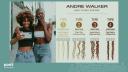
To help, I turn your attention to the Andre Walker hair typing system. So, hairstylist and businessman Andre Walker is known for maintaining Oprah Winfrey's hair for decades. So, if he did Oprah's hair clearly, he got something going on. He's also known for creating Halle Berry's pixie cut. In 1997, he created a numerical grading system for human hair types. The Andre Walker hair typing system classifies Afro-textured hair as type four. There are other types of hair defined as one for straight hair, type two for wavy, and type three for curly, with letters A, B, and C used to indicate the degree of coil variation in each type.
I use this system to break down all of the different data sets that we see in data science and what programming languages or tools we could use to run this analysis. For the sake of time, we won't use the whole table, but I have a QR code at the end because I spent a lot of time on this table, and I do want you to look at it later. But for the sake of time, we're going to focus on type four.
We'll focus on type four because that's my hair type. So, if your hair is type four like my hair, it's tightly coiled with no defined pattern. And I equate that to working with super messy data like text data, words, sentences, paragraphs of free-flowing text. It's unstructured. It's not neatly formatted into columns. And R is a fantastic tool to learn and to use in order to devise patterns from this type of data, trends, make predictions, and recommendations. You can use it to predict traffic, TikTok algorithms, and even detect unusual bank transactions.
Summary and organizations doing the work
So, I'll summarize. Like Afro-textured hair, there are levels to this thing that we call data science. And to break into it successfully, you have to build a strong foundation by learning about different types of data, what repositories are out there, how do you share and collaborate with others, how do you clean it, format it, et cetera. Once you have that foundation, so you've taken care of your roots, you have to determine the tools that are right for you to get the kind of analysis you want. Is it a pressing comb? Is it a latch hook? Is it braids? What are you doing with your data?
Whether you're using spreadsheets for a numerical operation or you want to jump into the 4B, that unstructured data, that not neatly formatted data, and use a tool like R. These are a few broad comparisons, but it's important to note that Afro-textured hair and data science are distinct and separate domains. However, exploring connections between seemingly unrelated topics can often lead to new creative insights and collaborations.
Putting this all together, I want to introduce you to a few organizations that are doing the work. These organizations are using their data science skills to positively impact Black and brown people's lives worldwide.
The first organization is Data for Black Lives. Data for Black Lives is a movement of activists, organizers, and scientists committed to using data to create concrete and measurable change in the lives of Black people. Through their research, advocacy, and community building, they support the vital work of grassroots racial justice organizations to challenge discriminatory uses of data and algorithms across systems. They have a national network of about 20,000 scientists, activists, those who are building a future where data and technology is used for good rather than instruments of oppression in the Black community.
The second organization is the Algorithmic Justice League, and this organization leads a cultural movement towards equitable and accountable artificial intelligence. Their mission is to raise public awareness about the impacts of AI, equip advocates with research to bolster their campaigns, and to build the voice and the choice of the most impacted communities. They galvanize policymakers, researchers, industry practitioners to mitigate AI bias and harm.
And, of course, the last organization is the Carpentries because, yes, we are the leading inclusive community teaching data and coding skills. We were founded to teach foundational computation and data science skills through short, impactful workshops, and our model is to train the trainer. We certify volunteer instructors, and they go out into the communities where they can reach people directly with these data skills. Our course material is open source. It's free to use. It's free to contribute to, and in this way, we're able to scale beyond our organization and build regional, self-sustaining learning communities.
Call to action
So, here's your call to action. Whether you choose to believe it or not, data is affecting your life every single day, from whether the TSA pats your hair down at the airport, which they do me every single time I fly, to what content appears on your social media feed. It's in your best interest to learn how to work with data and encourage others to, no matter your field of expertise.
It's in your best interest to learn how to work with data and encourage others to, no matter your field of expertise.
I'm sharing a few resources that I want you to watch, including the Hairtails documentary. It was really, really good. Keep in touch. I think we have time for a couple of questions, and thank you so much for your attention today.
Q&A
So, first up, how do you, as a black woman, deal with the inherent subconscious exhaustion that comes with continually showing up and working towards better representation? No, you know, I'm honest with myself, and I'm honest with my colleagues. Now, I do have a therapist, and I go to therapy every two weeks. And I think, you know, I think mental, just mental health in general is more understood now than it was even 20 years ago when I was in graduate school. And I have these conversations often with my therapist and then, you know, a close group of people. But then I also ask myself what's important to me. You know, if I'm being asked to do all the time, can you speak? Can you mentor? Can you do all these things? Sometimes I want to do it because I have a connection with the group or I have space, but sometimes I don't, and it's okay. And I pass it off to other people that I know would like those opportunities.
Next up, what changes would you like to see in the data science community to increase representation and better support diversity? I think language is super important. I think the blanket statements that I hear, there are no black women doing X or there are no, you know, trans people doing Y, I think we have to get away from using these very general statements. And get creative. One thing that we do at the Carpentries, we know we aren't the end-all be-all organization. And so we try to partner with other organizations who have more access to different communities that we want to work with. And I think it's the same for individuals. You know, I don't have a, I have a large community of black women who have PhDs. Like I could name 10 people right now, 10 black women right now who have PhDs because that's the communities that I belong to. But there may be another community that I don't have a lot of experience with. I'm going to go find them. I'm not going to create something from scratch. So I think that's super helpful. Not trying to do everything on your own, but collaborating with others.
This is a fantastic analogy. Have you considered expanding this as a longer talk or longer tutorial to welcome new people? I have. So this is the second time I did this talk. I first did it at Spelman College. And of course it was received well because it's a historically black college. All women, you know, historically black college. So it was definitely received well. I tweaked it a bit for this audience, but I have been thinking about kind of expanding it a little bit more because it seems to resonate with more than just, you know, black women. So that's pretty dope.