


Intro#
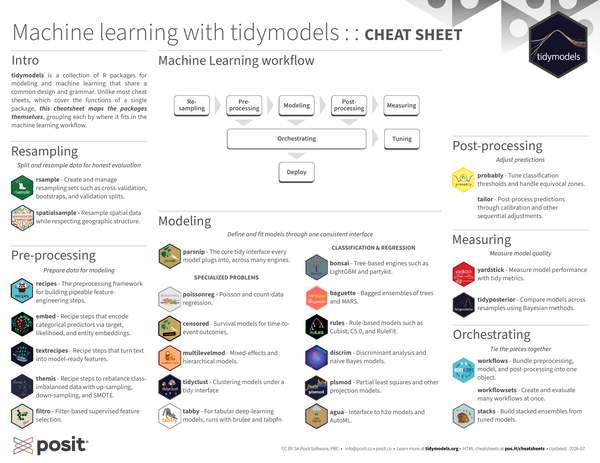
tidymodels is a collection of R packages for modeling and machine learning that share a common design and grammar. Unlike most cheatsheets, which cover the functions of a single package, this cheatsheet maps the packages themselves, grouping each by where it fits in the machine learning workflow.
The workflow runs from Resampling to Pre-processing, Modeling, Post-processing, and Measuring. Orchestrating spans pre-processing through post-processing, feeds into Tuning, and leads to Deploy.
Resampling#
Split and resample data for honest evaluation.
-
rsample - Create and manage resampling sets such as cross-validation, bootstraps, and validation splits.
-
spatialsample - Resample spatial data while respecting geographic structure.
Pre-processing#
Prepare data for modeling.
-
recipes - The preprocessing framework for building pipeable feature-engineering steps.
-
embed - Recipe steps that encode categorical predictors via target, likelihood, and entity embeddings.
-
textrecipes - Recipe steps that turn text into model-ready features.
-
themis - Recipe steps to rebalance class-imbalanced data with up-sampling, down-sampling, and SMOTE.
-
filtro - Filter-based supervised feature selection.
Modeling#
Define and fit models through one consistent interface.
Classification & regression#
-
parsnip - The core tidy interface every model plugs into, across many engines.
-
bonsai - Tree-based engines such as LightGBM and partykit.
-
baguette - Bagged ensembles of trees and MARS.
-
rules - Rule-based models such as Cubist, C5.0, and RuleFit.
-
discrim - Discriminant analysis and naive Bayes models.
Specialized problems#
-
poissonreg - Poisson and count-data regression.
-
censored - Survival models for time-to-event outcomes.
-
multilevelmod - Mixed-effects and hierarchical models.
-
tidyclust - Clustering models under a tidy interface.
-
plsmod - Partial least squares and other projection models.
-
tabby - Tabular deep-learning models; runs with brulee and tabpfn.
-
agua - Interface to h2o models and AutoML.
Post-processing#
Adjust predictions.
-
probably - Tune classification thresholds and handle equivocal zones.
-
tailor - Post-process predictions through calibration and other sequential adjustments.
Measuring#
Measure model quality.
-
yardstick - Measure model performance with tidy metrics.
-
tidyposterior - Compare models across resamples using Bayesian methods.
Orchestrating#
Tie the pieces together.
-
workflows - Bundle preprocessing, model, and post-processing into one object.
-
workflowsets - Create and evaluate many workflows at once.
-
stacks - Build stacked ensembles from tuned models.
Tuning#
Optimize hyperparameters.
-
tune - Run grid and iterative hyperparameter search.
-
dials - Define tuning parameters and build grids. Often called for you by tune.
-
finetune - Add search strategies such as racing and simulated annealing.
-
important - Measure predictor importance.
Deploy#
Put models into production.
Prepare & serve#
-
vetiver - Version, deploy, and monitor models in production.
-
butcher - Strip fitted models down to reduce object size.
-
applicable - Flag new samples that fall outside the training distribution.
Run in a database#
-
tidypredict - Generate SQL to score models inside a database.
-
modeldb - Fit models directly in a database.
-
orbital - Convert workflows into portable equations that can run in-database.
Data#
Datasets used in documentation, tests, and teaching.
-
modeldata - Over 40 example datasets bundled for modeling.
-
modeldatatoo - Over half a dozen larger datasets downloaded on demand.
Deep learning#
R packages that implement or wrap tabular deep-learning models.
-
brulee - Torch-based models, from MLPs to ResNet and SAINT.
-
tabpfn - A pretrained transformer that predicts tabular data with no training.
Other#
General#
-
broom - Convert model objects into tidy tibbles.
-
infer - Run statistical inference and hypothesis tests.
-
corrr - Explore correlations in a data frame.
Development#
- hardhat - Scaffold new modeling packages.
The tidymodels package#
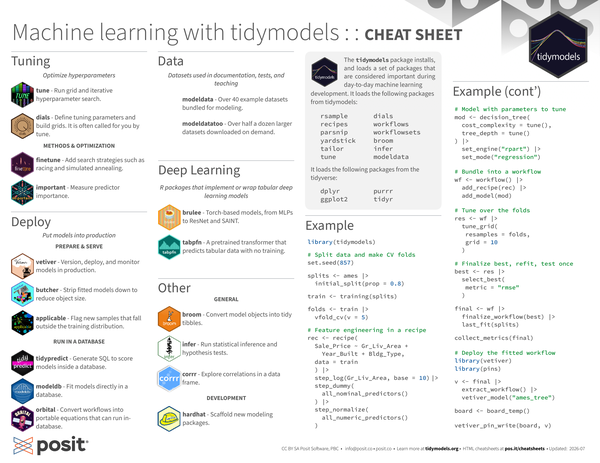
The tidymodels package installs and loads a set of packages that are considered important during day-to-day machine learning development.
It loads the following packages from tidymodels:
rsamplerecipesparsnipyardsticktailortunedialsworkflowsworkflowsetsbroominfermodeldata
It also loads the following packages from the tidyverse:
dplyrggplot2purrrtidyr
Example#
A complete workflow: split, engineer features, tune, finalize, and deploy.
library(tidymodels)

# Split data and make CV folds
set.seed(857)

splits <- ames |>
  initial_split(prop = 0.8)
train <- training(splits)
folds <- train |>
  vfold_cv(v = 5)

# Feature engineering in a recipe
rec <- recipe(
  Sale_Price ~ Gr_Liv_Area + Year_Built + Bldg_Type,
  data = train
) |>
  step_log(Gr_Liv_Area, base = 10) |>
  step_dummy(all_nominal_predictors()) |>
  step_normalize(all_numeric_predictors())

# Model with parameters to tune
mod <- decision_tree(
  cost_complexity = tune(),
  tree_depth = tune()
) |>
  set_engine("rpart") |>
  set_mode("regression")

# Bundle into a workflow
wf <- workflow() |>
  add_recipe(rec) |>
  add_model(mod)

# Tune over the folds
res <- wf |>
  tune_grid(
    resamples = folds,
    grid = 10
  )

# Finalize best, refit, test once
best <- res |>
  select_best(metric = "rmse")
final <- wf |>
  finalize_workflow(best) |>
  last_fit(splits)

collect_metrics(final)

# Deploy the fitted workflow
library(vetiver)
library(pins)

v <- final |>
  extract_workflow() |>
  vetiver_model("ames_tree")

board <- board_temp()
vetiver_pin_write(board, v)